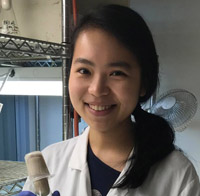
Jiayan Tan
Biochemistry & Cell Biology
- Profile
Profile
Jiayan is one of those especially bright undergraduates (she passed 13 AP exams in high school) who help keep the research machine in motion at UC San Diego. She started research in the States Lab at UC San Francisco when still a junior at Lowell High School (“The number-one best public high school in San Francisco!”) and currently volunteers as a research assistant in the lab of Distinguished Professor Susan Golden, where she’s charged with high-level responsibilities. For example, “I get to induce mutation in cyanobacteria on critical genes and study their phenotypes. I am often both surprised and fascinated by the many possibilities in gene-to-gene interactions and their corresponding phenotypes.”
Jiayan has been acknowledged in three published or in-press research papers, and has presented her research in a series of symposia and conferences, including the 31 st annual UC San Diego Undergraduate Research Conference. She was recently awarded the Milton Saier Memorial Award for "Outstanding Original Research Achievement in Prokaryotic Biology.”
Jiayan love puzzles. “I enjoy most in deciding what chemical molecule to use because this task requires consideration of a lot of factors like miscibility and potential side effects. I like to challenge myself because I feel accomplished when I find the molecule that works.” Her academic promise has been recognized through her award as a McNair Scholar, a competitive federal program that involves a coveted summer study experience.
Jiayan describes herself as stubbornly curious from an early age, and recognizes that the drive to unravel and understand is what is pointing her toward a PhD in research, especially related to genetics.
“A potential career I am considering is to become a pharmacogenomics researcher who studies how genes affect people’s response to drugs, and designs for a safe drug that is specific to an individual’s genetic makeup. I hope to discover a drug that can cure or repress human diseases.”